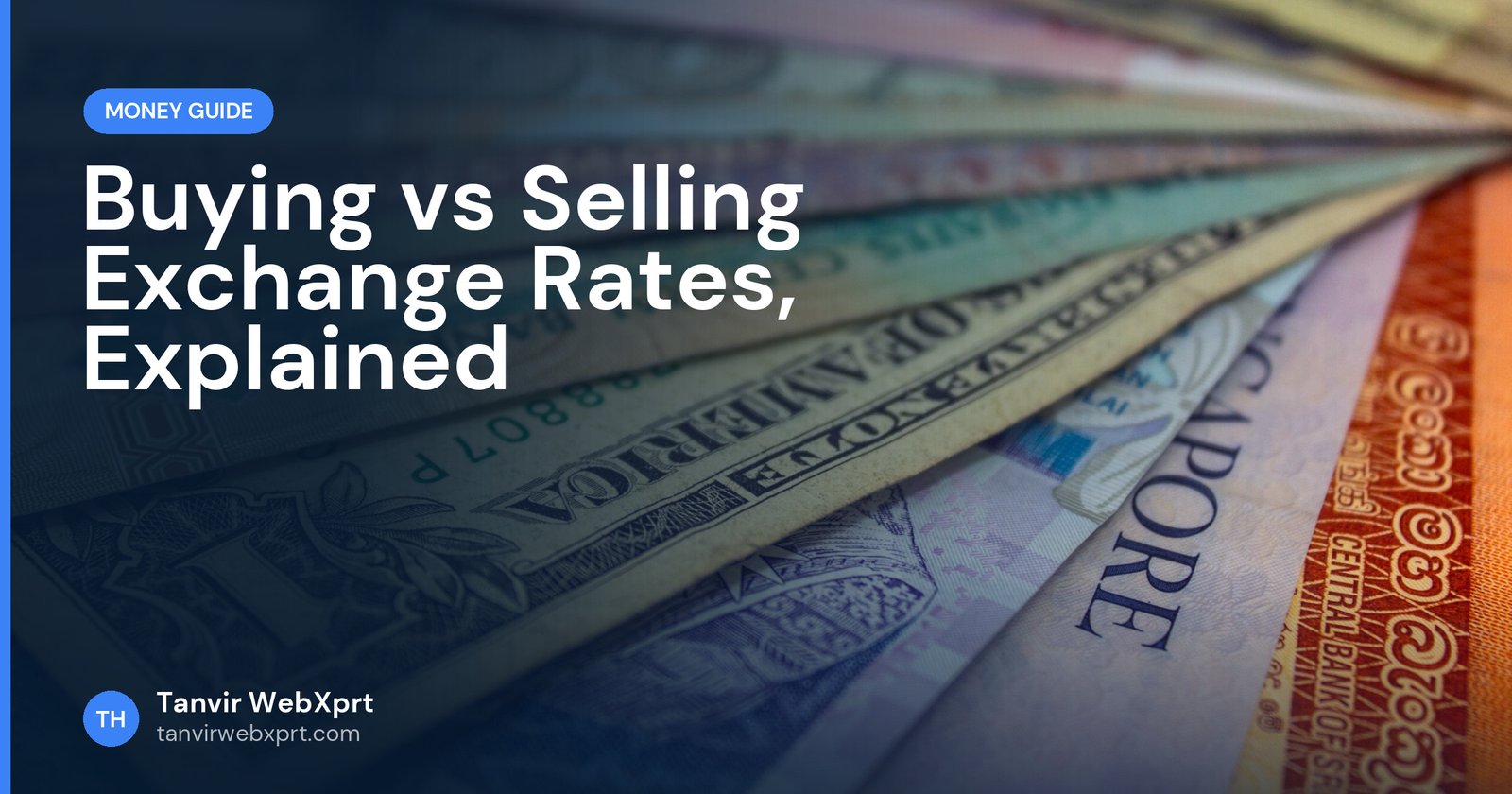
Every bank and money changer shows two rates for each currency: the buying rate (the price at which they buy foreign currency from you) and the selling rate (the price at which they sell it to you). The selling rate is always higher, and the gap between the two, called the spread, is how they earn money. When you bring dollars home, you get the buying rate; when you need dollars for travel or study, you pay the selling rate. The mid-market rate you see on Google sits roughly in the middle.
- Buying rate: what they pay you. Selling rate: what you pay them.
- The spread is the hidden cost of exchanging money.
- Cash rates, card rates and transfer rates can all be different.
- Compare the rate you are offered with the mid-market rate.
- Check the mid-market rate in the free Currency Converter.
“Why is your rate different from Google?”
Picture a student who comes back from a short course in Malaysia with $200 left over. Google shows one rate for USD to BDT. The money changer offers less per dollar. A week later, his sister needs dollars for her own trip, and the same shop sells them for more than Google’s rate.
Nobody is lying. Google shows the mid-market rate; the shop shows its buying and selling rates. Knowing how to read them helps you spot a fair deal.
How to read a rate board
| Currency | We buy | We sell |
|---|---|---|
| USD | Lower number | Higher number |
- “We buy” (buying rate): you give them dollars, they give you taka at this rate.
- “We sell” (selling rate): you give them taka, they give you dollars at this rate.
The words are always from the bank’s or shop’s point of view, which is why they can feel backwards.
The spread: the real cost of exchanging
The spread is the difference between the selling and buying rates. If you exchanged taka to dollars and immediately back again, the spread is roughly what you would lose. A smaller spread means a better deal. Popular currencies such as the US dollar usually have smaller spreads than less traded ones.
Different rates for different methods
Tips for getting a fair rate
- Check the mid-market rateOn the Currency Converter before you go.
- Ask for the total“How many taka will I get for 200 dollars, after all charges?”
- Compare two placesBank vs licensed money changer, for example.
- Avoid last-minute exchangesAirports and hotels are convenient but usually expensive.
- Use licensed providersAlways get a receipt.
Related guides
Read mid-market rate vs bank rate, what moves exchange rates and card fees and the conversion trap.
This guide is general information, not financial advice.
Sources
Frequently asked questions
What is the difference between buying and selling rates?
The buying rate is what a bank or money changer pays you for foreign currency. The selling rate is what you pay them to get foreign currency. The selling rate is higher.
What is the spread in currency exchange?
The difference between the selling and buying rates. It is how exchange providers earn money and is part of your cost.
Why is the bank rate different from Google?
Google shows the mid-market rate. Banks and money changers add a margin on each side, which creates buying and selling rates.
Are cash exchange rates worse than card rates?
Often yes. Cash exchange usually has a wider spread than card or bank transfer conversions.
How can I get a better exchange rate?
Check the mid-market rate, ask for the total after all charges, compare two licensed providers and avoid airport counters.
Convert USD, BDT, EUR, GBP and 150+ currencies with up-to-date exchange rates.
Guides for this tool
 Guide · 3 min readUSD to BDT: How to Check the Real Rate and Avoid Hidden Fees
 Guide · 3 min readMid-Market Rate vs Bank Rate: How Exchange Rates Really Work
 Guide · 4 min readHow Freelancers in Bangladesh Receive International Payments
 Guide · 3 min readHow to Send Money to Bangladesh: Compare Costs and Get More Taka
Want a tool, website or app like this for your business?
Every free tool on this site is designed and coded by Tanvir H, a Bangladesh-based WordPress and Elementor web designer with 7+ years of experience and 650+ projects for clients worldwide. Fast, mobile-first, search-optimised websites that turn visitors into customers.
- 650+ projects
- 7+ years
- 4.9★ rating
- Govt. registered freelancer